Higgsfield API
- Type
- Guide
- Updated
- Nov 5, 2026First version. API docs, console pricing and help center checked on 5 Nov 2026. Full history
- Read
- 13 min
- Written by
- Max Panych

Yes, Higgsfield has a real developer API, and it is a separate product from the Higgsfield plan you use on the website. Here is how to get a key, the official code to make your first image, what it costs in dollars, and when MCP or the CLI is the better choice for your AI automation.
I may earn a commission if you buy through links on this page, at no extra cost to you. It never changes my verdict. How I make money
maxpanychHiggsfield
 Guide
On this page10 sections
- minimum API top-up, per Higgsfield (5 Nov 2026)
- $5
- per Soul 2 image on the API price list
- from $0.003
- concurrent requests, based on funds added in 28 days
- 2 to 40
- An Open Higgsfield account (open.higgsfield.ai)
- A card and at least $5 of balance
- An API key ID and secret
- Python 3.8+, Node.js, or curl and jq
- A server or backend to keep the key on
Create an API account at open.higgsfield.ai
The API console is called Open Higgsfield and lives at open.higgsfield.ai. The older console.higgsfield.ai and cloud.higgsfield.ai addresses redirect there. Sign up as an individual or a company. This is a separate account from your higgsfield.ai subscription, and you do not need a Higgsfield plan to use it.
Add a payment method and fund your balance
Billing is pay as you go from a prepaid USD balance. Higgsfield's help center says the minimum top-up is $5, funds expire one year after you add them, and the balance cannot go below zero. Turn on auto top-up only if you run production traffic.
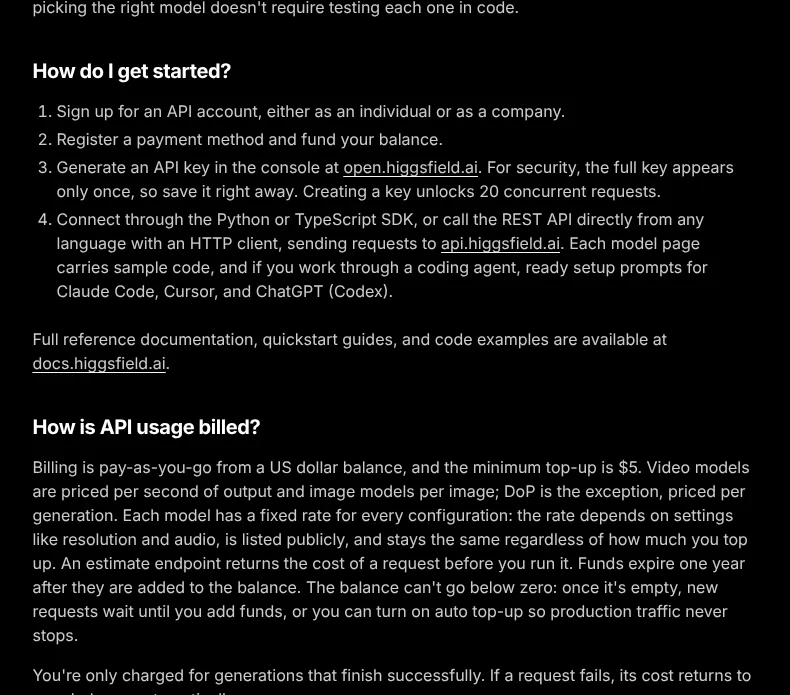
Generate an API key and save it right away
Open API keys in the console sidebar and create a key. Each credential is a key ID plus a secret, and Higgsfield shows the full key only once, so put it straight into a password manager or your secrets store. Lost it? You have to create a new one.
Store the key server-side
Set the credentials as environment variables on your server, never in browser or mobile code. The docs use
HF_API_KEY_IDandHF_API_KEY_SECRETfor curl,HF_KEYfor Python andHF_CREDENTIALSfor TypeScript, each in the formatkey-id:secret.Send your first request
Install the Python client with
pip install higgsfield-client(ornpm install @higgsfield/client), or call the REST endpoint with curl. Every request is asynchronous: you get arequest_id, then pollstatus_urlor wait for a webhook until the status iscompleted.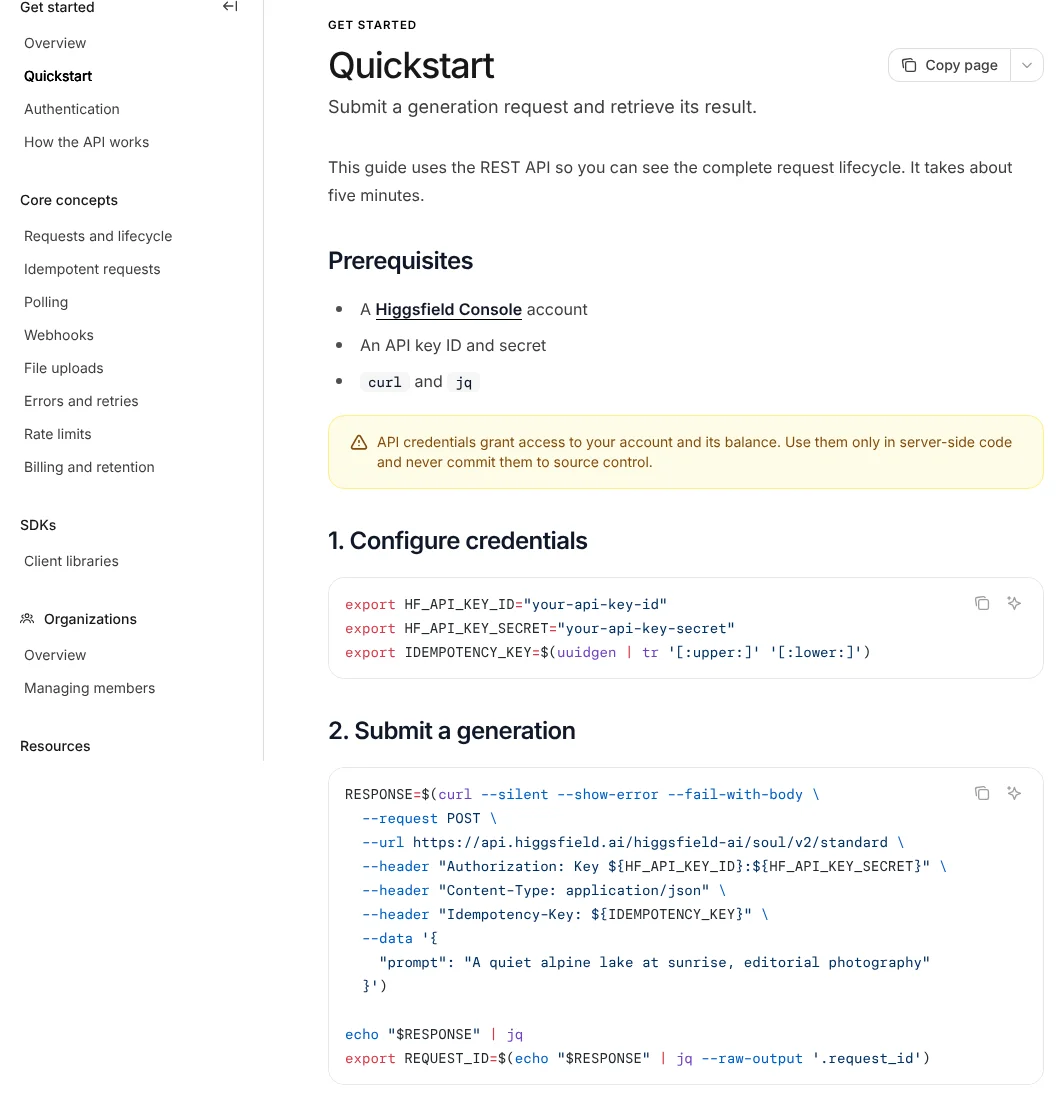
Estimate the cost before you scale
Send the same parameters to the
/estimate/endpoint and the API returns the price in USD before you generate anything. Then watch Analytics and Billing in the console after your first batch.
Yes, Higgsfield has an API. It is a pay-as-you-go REST API at api.higgsfield.ai, with official Python and TypeScript clients, keys you create at open.higgsfield.ai, and prices charged in US dollars per image or per second of video, not in plan credits.
That last part trips people up. The API is a separate product from the Higgsfield subscription, and for most creators it is not the right tool at all. I use Higgsfield every day through the Higgsfield MCP inside Claude on my Creator plan, not through the API. This guide is for the people who do need the API, and for anyone trying to work out which of the three routes fits their AI automation plans.
Everything below comes from Higgsfield’s API docs, its API pricing page and its help center article on the API, all checked on 5 Nov 2026.
Does Higgsfield have an API?
Yes, and it is a proper developer product, not a waitlist. Some review sites still say Higgsfield has “no public API”, which was out of date when I checked. Here is what Higgsfield actually ships:
| Piece | What it is | Where |
|---|---|---|
| REST API | Base URL https://api.higgsfield.ai, one endpoint per model | docs.higgsfield.ai |
| Console (Open Higgsfield) | API keys, playground, pricing, analytics, billing | open.higgsfield.ai |
| Python client | pip install higgsfield-client, sync and async, Python 3.8+ | GitHub: higgsfield-client |
| TypeScript client | npm install @higgsfield/client, server-side only | GitHub: higgsfield-js |
| Model catalog | 84 documented entries, 17 image and 67 video | Model API reference |
| Webhooks | Completion notifications with signature verification | Webhooks |
The help center says one API key opens every model in the API catalog, including Seedance, Kling, Wan, MiniMax, PixVerse, LTX and Grok for video, Ideogram, Recraft and Qwen for images, plus Higgsfield’s own Soul 2, Soul Cinema, DoP and Marketing Studio Image. It also warns that the API catalog may differ from the model lineup on higgsfield.ai. For example, I did not find Nano Banana, the image model I use most through MCP, on the API’s image generation page.
Note: The developer console has had three addresses. Higgsfield’s docs still link to console.higgsfield.ai, older guides say “Higgsfield Cloud” at cloud.higgsfield.ai, and both now redirect to open.higgsfield.ai, which the help center calls Open Higgsfield. Same product, same keys.
How do I get a Higgsfield API key?
The steps above follow Higgsfield’s own getting-started list. The short version: sign up at open.higgsfield.ai, add a card, fund the balance with at least $5, open API keys, create a key and copy it before you close the dialog, because Higgsfield shows the full key only once.
A key has two parts, a key ID and a secret, and the API wants both in one header:
Authorization: Key YOUR_KEY_ID:YOUR_KEY_SECRET
The docs are blunt about where it lives: server-side only. Anyone who can inspect a browser or mobile app can pull the secret out and spend your balance. Use separate keys for development and production, and rotate a key straight away if it may have leaked. A missing or wrong key returns 401 Unauthorized.
Warning: Do not paste your API secret into a ChatGPT or Claude chat to “help debug”. The docs say never to put credentials in URLs, logs, screenshots or support messages. Put it in an environment variable and let your code read it.
What does a Higgsfield API request look like?
Generation is asynchronous. You POST to a model endpoint, the API answers at once with a request_id, a status_url and a cancel_url with status queued, and you poll or wait for a webhook until the status is completed. The other final statuses are failed, nsfw and canceled.
Python example (official higgsfield-client)
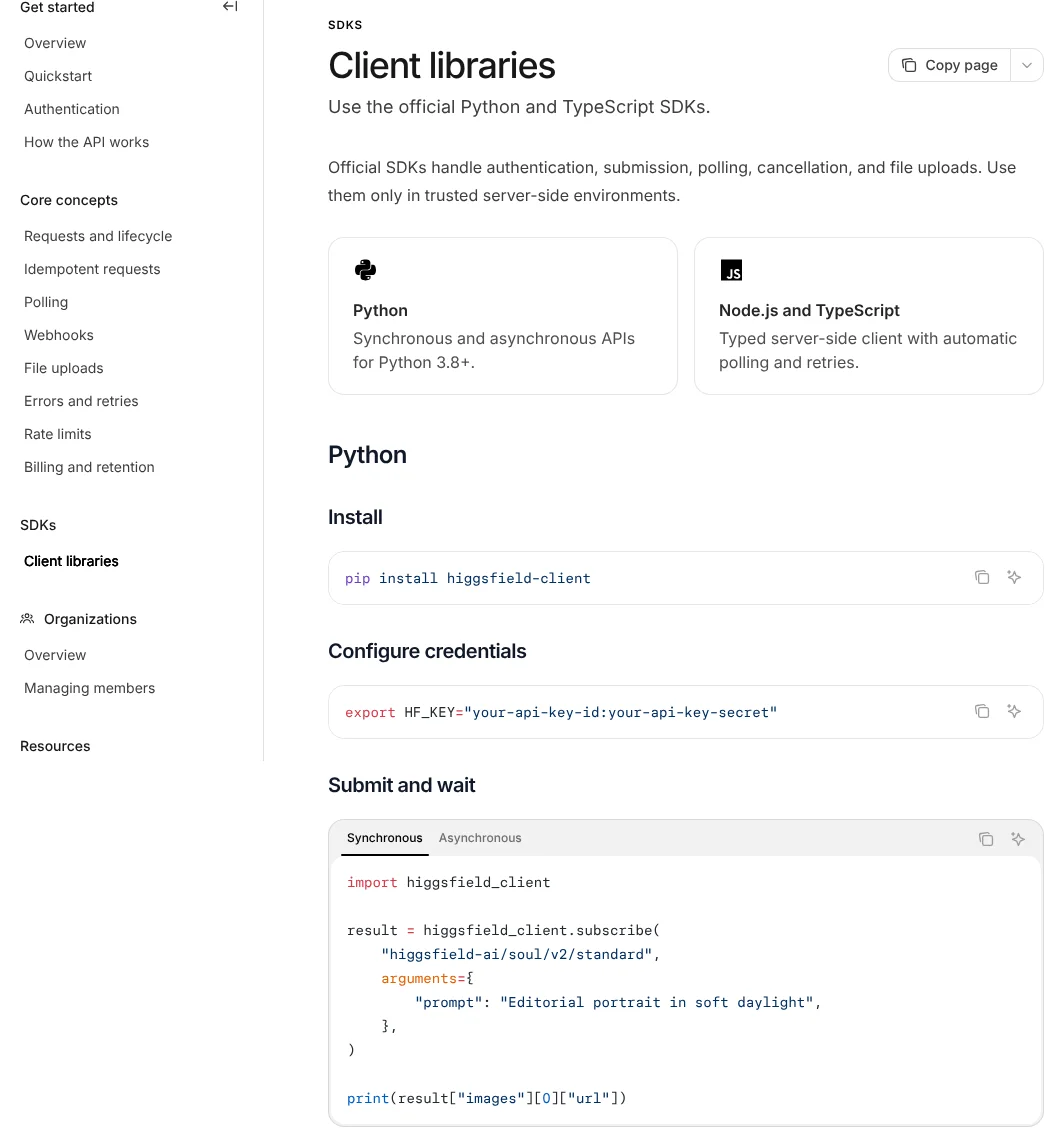
This is the synchronous example from Higgsfield’s client libraries page, unchanged. It generates one Soul 2 image and prints its URL. subscribe submits the job and waits for the result for you.
pip install higgsfield-client
export HF_KEY="your-api-key-id:your-api-key-secret"
import higgsfield_client

result = higgsfield_client.subscribe(
    "higgsfield-ai/soul/v2/standard",
    arguments={
        "prompt": "Editorial portrait in soft daylight",
    },
)

print(result["images"][0]["url"])
The Python client also has subscribe_async, submit for explicit polling and cancellation, and upload, upload_file and upload_image helpers for input media.
REST example with curl
From Higgsfield’s Quickstart, which uses plain REST so you can see every step. The Idempotency-Key lets you resend a request after a timeout without paying twice.
export HF_API_KEY_ID="your-api-key-id"
export HF_API_KEY_SECRET="your-api-key-secret"
export IDEMPOTENCY_KEY=$(uuidgen | tr '[:upper:]' '[:lower:]')

RESPONSE=$(curl --silent --show-error --fail-with-body \
  --request POST \
  --url https://api.higgsfield.ai/higgsfield-ai/soul/v2/standard \
  --header "Authorization: Key ${HF_API_KEY_ID}:${HF_API_KEY_SECRET}" \
  --header "Content-Type: application/json" \
  --header "Idempotency-Key: ${IDEMPOTENCY_KEY}" \
  --data '{
    "prompt": "A quiet alpine lake at sunrise, editorial photography"
  }')

export REQUEST_ID=$(echo "$RESPONSE" | jq --raw-output '.request_id')

curl --silent --show-error --fail-with-body \
  --url "https://api.higgsfield.ai/requests/${REQUEST_ID}/status" \
  --header "Authorization: Key ${HF_API_KEY_ID}:${HF_API_KEY_SECRET}" | jq
TypeScript and other languages
The Node.js client installs with npm install @higgsfield/client, reads credentials from HF_CREDENTIALS, and its v2 higgsfield.subscribe() call takes the same model path and an input object. Higgsfield says the v2 client blocks browser use on purpose. For PHP, Go, Ruby or anything else, call the REST endpoints with any HTTP client. Each model page in the console also has a “Copy for agent” setup prompt for Claude Code, Cursor and ChatGPT (Codex), which is handy if you let a coding agent write the integration.
Tip: Output files are kept for seven days after a request finishes, then deleted. Build the “download to my own storage” step into your first script, not as an afterthought.
How much does the Higgsfield API cost?
The Higgsfield API costs from $0.003 per image and from about $0.025 to $0.32 per second of video, paid from a prepaid USD balance with a $5 minimum top-up. These are API prices, and they have nothing to do with the Starter, Plus and Ultra plans. For those, see my Higgsfield AI pricing guide.
Higgsfield’s help center spells out the billing rules (checked 5 Nov 2026):
- Video is priced per second of output, images per image, and DoP per generation.
- Each model has a fixed public rate per configuration, which changes with settings like resolution and audio, but not with how much you top up.
- You pay only for successful generations. Requests that end as
failedornsfware refunded automatically, and a queued request you cancel is refunded too. - Funds expire one year after you add them. When the balance hits zero, new requests wait until you add funds.
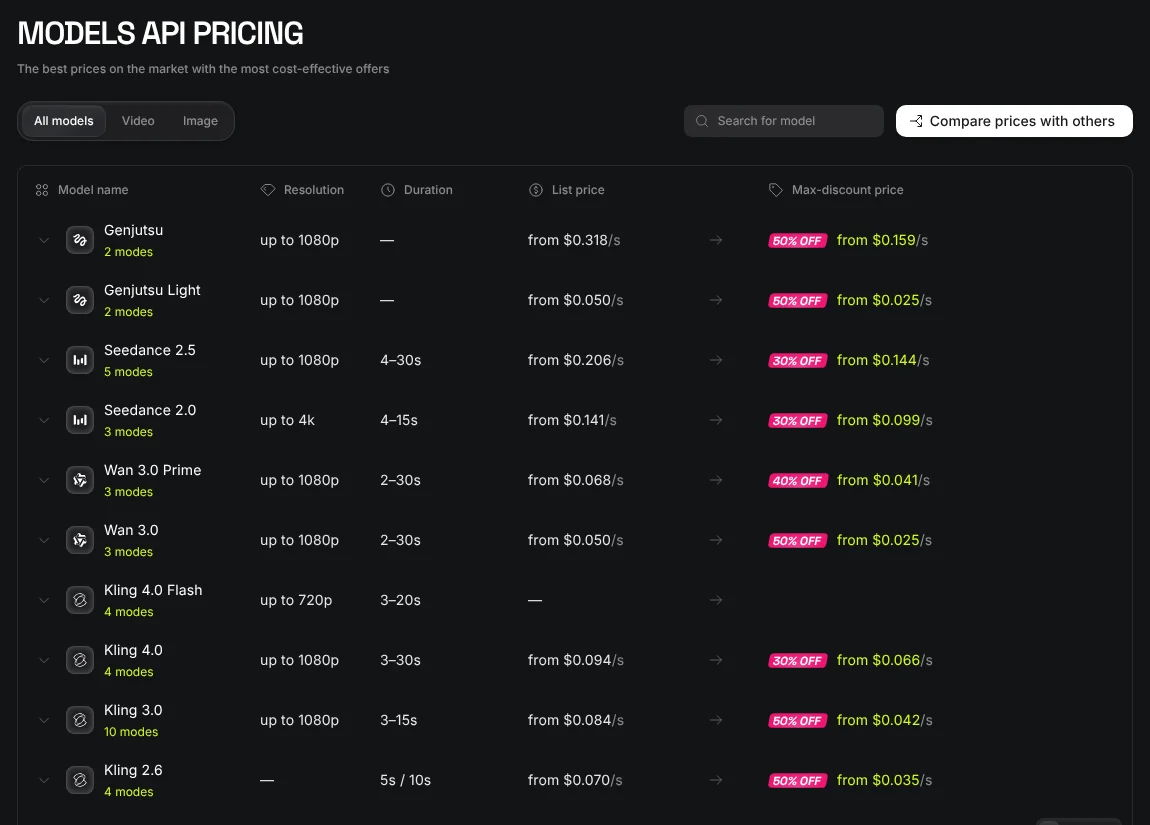
The pricing page shows two prices per model: a list price and a “max-discount” price. The discount comes from the launch offer, which as of 5 Nov 2026 gives 15% off all sale models when you sign up and lets you pick any 3 models for discounts of up to 75%. Verify a business email and add a card and Higgsfield adds $15 to your balance.
Higgsfield API video prices
Starting prices from the API pricing page, checked 5 Nov 2026. “From” means the cheapest configuration; higher resolution or audio costs more.
| Video model | List price | Max-discount price | 10 second clip at list | Resolution, length |
|---|---|---|---|---|
| Genjutsu | $0.318/s | $0.159/s | $3.18 | Up to 1080p |
| Genjutsu Light | $0.050/s | $0.025/s | $0.50 | Up to 1080p |
| Seedance 2.5 | $0.206/s | $0.144/s | $2.06 | Up to 1080p, 4 to 30s |
| Seedance 2.0 | $0.141/s | $0.099/s | $1.41 | Up to 4K, 4 to 15s |
| Wan 3.0 Prime | $0.068/s | $0.041/s | $0.68 | Up to 1080p, 2 to 30s |
| Wan 3.0 | $0.050/s | $0.025/s | $0.50 | Up to 1080p, 2 to 30s |
| Kling 4.0 | $0.094/s | $0.066/s | $0.94 | Up to 1080p, 3 to 30s |
| Kling 3.0 | $0.084/s | $0.042/s | $0.84 | Up to 1080p, 3 to 15s |
| Kling 2.6 | $0.070/s | $0.035/s | $0.70 | 5s or 10s |
Higgsfield API, cost of a 10 second clip at list price
- Genjutsu$3.18
- Seedance 2.5$2.06
- Seedance 2.0$1.41
- Kling 4.0$0.94
- Kling 3.0$0.84
- Kling 2.6$0.70
- Wan 3.0 Prime$0.68
- Wan 3.0$0.50
- Genjutsu Light$0.50
Higgsfield API image prices
From the Explore models page in the console, checked 5 Nov 2026:
| Image model | Price per image |
|---|---|
| Soul 2 | From $0.003 |
| Marketing Studio Image | From $0.014 (15% off $0.016) |
| Z-Image Turbo | $0.015 |
| Ideogram 4.0 | $0.030 |
| Recraft 4.1 | $0.035 |
| Grok Imagine 2.0 | From $0.040 |
| Qwen Image 3 | From $0.040 |
| AI Influencer character sheet | $0.050 |
| Soul Standard | From $0.094 |
To check a price before you spend, the docs have an estimate endpoint. Send it the same body you would send to the model:
curl --request POST \
  --url https://api.higgsfield.ai/estimate/higgsfield-ai/soul/v2/standard \
  --header "Authorization: Key ${HF_API_KEY_ID}:${HF_API_KEY_SECRET}" \
  --header "Content-Type: application/json" \
  --data '{"prompt": "Editorial portrait in soft daylight"}'
It answers with a USD amount, such as {"usd": "0.094"} in the docs’ example, which Higgsfield says only illustrates the format.
Is the API cheaper than my Higgsfield plan?
It is hard to compare like for like, because the API’s “from” prices are the cheapest settings and plan credits buy different things on different models. As a rough check: Higgsfield’s Claude video guide, which I quote in my MCP guide, puts a 10 second 720p Seedance 2.5 clip at 70 credits, about $3.43 at its “$49 for 1,000 credits” rate. On the API, a 10 second Seedance 2.5 clip starts at $2.06 at list price, before discounts and before any higher settings.
Max’s take: For my volume, the plan still wins, because images on Creator barely move my balance (3 credits for a Nano Banana 2.1 image, 1 credit for a background removal in my 5 Nov 2026 log) and I get Higgsfield’s full web tools. The API makes sense when software, not a person, is doing the generating.
What are the Higgsfield API rate limits?
The main limit is concurrency, the number of requests that can be processing at the same time. On the pricing page, concurrency grows with the money you have added in the past 28 days:
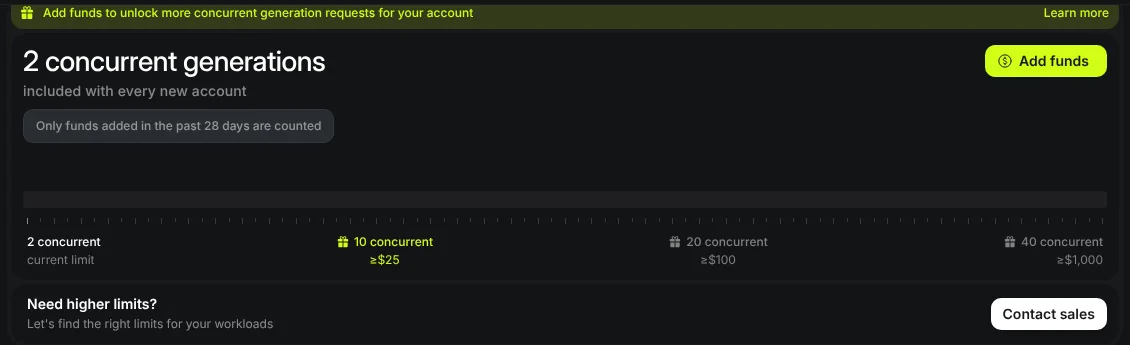
Higgsfield API concurrent requests by funds added in the past 28 days
- New account2
- $25 or more10
- $100 or more20
- $1,000 or more40
Two sources disagree a little here. The same pricing page’s FAQ and the help center both say your first API key comes with 20 concurrent requests as part of the launch offer. The docs say the limits shown in your own console dashboard are the ones that count, so check there after you create a key.
What happens at the limit, per the rate limits page:
- Over your concurrency limit: the request is still accepted and queued, and starts on its own when a running request finishes.
- Queue full: the queue is capped at a multiple of your concurrency, counting each output of a batch. A new request then gets
429 Too Many Requestswith aRetry-Afterheader and codeaccount_queue_full, and nothing is created or charged. - Some models have their own limits on top of the account limit. Training Soul ID references, for example, rejects requests over its own concurrent cap.
- No rate-limit headers yet on successful responses, so you cannot read your remaining capacity from the API.
Higgsfield’s advice is to submit through a worker pool sized to your concurrency, back off on 429s with jitter, resend with the same Idempotency-Key, and keep polling traffic separate from submissions.
Higgsfield API vs MCP vs CLI: which should you use?
Higgsfield now offers three ways in besides the website, and they split cleanly by who is doing the work. The help center’s own comparison:
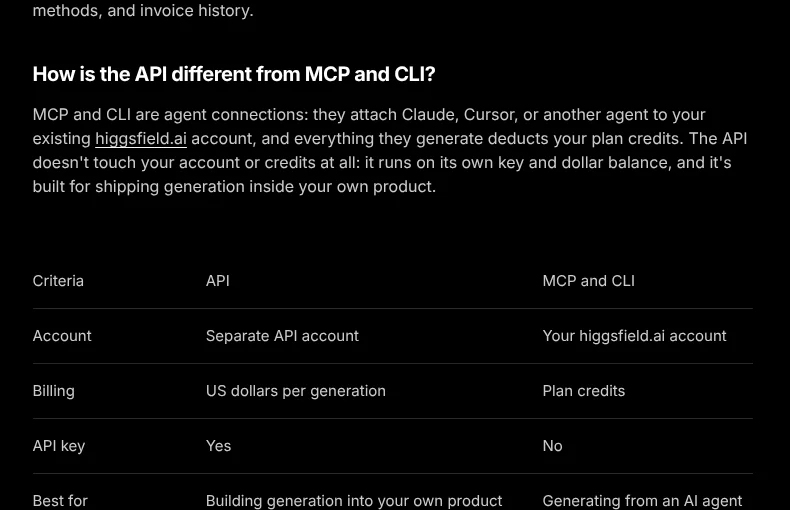
| Higgsfield API | Higgsfield MCP | Higgsfield CLI and Skills | |
|---|---|---|---|
| Who it is for | Developers building generation into an app or pipeline | People working in a chat assistant | People working in a coding agent |
| Works in | Your own code, any language | Claude, ChatGPT, Cursor, other MCP clients | Claude Code, Cursor, Codex |
| Account | Separate API account at open.higgsfield.ai | Your higgsfield.ai account | Your higgsfield.ai account |
| Pays with | Prepaid USD balance, per generation | Plan credits | Plan credits |
| Needs an API key | Yes | No, you sign in | No, higgsfield auth login |
| Needs a Higgsfield plan | No | Yes, a paid plan | Uses your plan credits |
| Unlimited offers apply | Not applicable | No | No |
| Setup | Key plus SDK or REST | Add https://mcp.higgsfield.ai/mcp as a connector | npx skills add higgsfield-ai/skills |
Sources: Higgsfield’s API help article and its CLI help article, checked 5 Nov 2026. The CLI article says MCP suits chat agents and exposes every tool with free parameter choice, while CLI and Skills suits coding agents, with structured skills (generate, soul and product-photoshoot) and lower token overhead. It also says you do not need both.
Who should use which
- You make content yourself, in a chat: use the MCP. This is me. I ask Claude for an image or a background removal and it comes back in the chat, paid from my Creator plan. My Higgsfield MCP guide has the setup.
- You live in Claude Code or Cursor: use the CLI and Skills. Same account and credits as MCP, built for coding agents.
- You are building a product, a client tool or an automated pipeline: use the API. Think a real estate app that turns listing photos into video tours, an agency system that makes 200 ad variants overnight, or an n8n or Make workflow that calls Higgsfield from a webhook. Nobody is sitting in a chat, so you want keys, webhooks, idempotency and per-request billing.
- You only want images and clips for your own social posts: you probably do not need any of this. The website or the MCP is enough. If you are still deciding whether Higgsfield is worth paying for at all, read my Higgsfield AI review.
If I ever automate renders from Buildme site photos without me in the loop, the API is where I would start, because that is software doing the generating, not me.
What to know before you build on it
A few things from the docs that are easy to miss until they bite:
- Model availability is per account. A model you are not allowed to use can return
404,423or503, so do not read a 404 as “endpoint does not exist” without checking the console. - Files disappear after seven days. Download outputs to your own storage. You can shorten retention with the
Hf-Expires-Afterheader (one hour or more) or delete a request withDELETE /requests/{request_id}. - Input media must be public URLs or uploaded to Higgsfield storage first. The Genjutsu motion transfer endpoint, for example, needs a source video of at least 4 seconds.
- Use webhooks in production, and keep polling as a fallback. Higgsfield signs webhook calls so you can verify them.
- Enterprise options exist: invoice billing on a committed-use contract, SSO, organizations and roles, model training opt-out and dedicated capacity, per the Enterprise API docs.
- Commercial use is allowed. The help center says you hold the rights to generated content under Higgsfield’s Terms of Use, including for products, ads and client work.
Tip: Moving from fal or Replicate? Higgsfield’s pricing FAQ says the submit, check status, fetch result flow stays the same, and you mainly change credentials, endpoints and model parameters. Its comparison table, based on prices as of 16 September 2026, lists Kling 3.0 Pro at $0.084 per second on Higgsfield against $0.168 on fal.
Bottom line
The Higgsfield API is real, documented and simple: one header, one async request pattern, official Python and TypeScript clients, and dollar prices you can check before you spend. It is the right choice when your own software generates the images or video. If you are a creator or business owner generating content yourself, the MCP in Claude or the website on a plan is simpler, and that is how I use Higgsfield every day.
Questions people ask
01Does Higgsfield have an API?
Yes. Higgsfield has a public developer API at api.higgsfield.ai, documented at docs.higgsfield.ai, with official Python and TypeScript SDKs. You manage keys, billing and usage in the console at open.higgsfield.ai. It is a separate product from the higgsfield.ai subscription, with its own account and a USD balance.
02Is the Higgsfield API free?
No. It is pay per generation from a prepaid balance, with a $5 minimum top-up. The API playground in the console is free to open, and as of 5 Nov 2026 Higgsfield's launch offer gives $15 of balance when you verify a business email and add a card, plus discounts on selected models. Failed and moderated requests are refunded automatically.
03Can I use my Higgsfield subscription credits with the API?
No. Higgsfield's help center says the plan and the API are two separate products with separate billing. Your plan credits and Unlimited access only exist on the website, MCP and CLI. The API runs on its own dollar balance, and having a plan does not change API access or rates.
04Is there a Higgsfield API for JavaScript or Node.js?
Yes. The official TypeScript client is installed with npm install @higgsfield/client and imported from @higgsfield/client/v2. It is server-side only and blocks browser use so your secret cannot leak. Any other language can call the REST API directly with an HTTP client.
05What are the Higgsfield API rate limits?
The main limit is concurrency, the number of requests processing at once. The pricing page shows 2 concurrent generations for a new account, 10 once you have added $25 or more in the past 28 days, 20 at $100 and 40 at $1,000. The launch offer says your first key comes with 20. Requests over the limit queue, and a full queue returns 429 Too Many Requests.
06Do I need an API key for the Higgsfield MCP?
No. The Higgsfield MCP and the Higgsfield CLI sign in with your normal higgsfield.ai account and spend your plan credits. API keys are only for the developer API.
07How long does Higgsfield keep API outputs?
Higgsfield's docs say request files are kept for seven days after the request finishes, then deleted. Download every finished image or video to your own storage. You can shorten retention with the Hf-Expires-After header or delete a request right away.
08Can I use Higgsfield API outputs commercially?
Higgsfield's help center says yes: under its Terms of Use you hold the rights to your generated content, so API outputs can go into commercial products, ads and client work. Check the terms yourself for your use case.
More in AI automation
Update history
- First version. API docs, console pricing and help center checked on 5 Nov 2026.